

Table of contents
To fuel a backyard ultra, aim for 60–90g of carbohydrate and 500–750ml of fluid with electrolytes every single hour — sports nutrition on the loop, easy real food at base camp.
Prioritise carbohydrate over protein and fat. Taper your training for 10–14 days, carb load and taper fibre for the final three days, and never test anything new on race day.
That's the whole strategy. The rest of this guide is how you make it repeatable at hour fourteen, when decision-making is the first thing to go.
Backyard ultras are booming. What's the fuss about running in circles?
As the new kid on the ultra block, backyard ultras are one of the fastest-growing formats in global running. What started as a niche has become a mainstream endurance subculture — and the appeal comes down to three things.
1. Superb inclusivity
Unlike a road marathon or a mountain ultra, all you have to do to stay in the race is finish the 4.167 mile (6.7km) loop inside the hour, and be on the start line again when the whistle blows. A comfortable 7min/km brings you home in around 47 minutes — leaving 13 minutes to rest and refuel before the next whistle.
That inclusive pace and return-to-base format has made backyard ultras hugely popular with beginners and intermediate runners tackling their first ultra-distance milestone. No getting lost on course. Proper toilets. Your own support crew, on the hour, every hour.
2. Mind over matter
The hourly loop strips away the pressure of chasing a finish time. Instead you get one pure, addictive question: can I stand up and do one more? It levels the playing field, turning the event into a psychological chess match where mental strength, stubbornness and smart fuelling routinely beat raw speed.
3. Community over competition
Because every runner returns to the same base camp every hour, these events feel like a weekend-long festival. Pumping tunes, street food, camp chairs — and at the sharp end, runners still going after days on the same loop. Pack the coffee thermos and the sleeping bag. The format breeds real camaraderie: you'll spend hours running shoulder to shoulder, sharing crew space and talking each other into one more lap.
Sounds like fun? Then let's talk about the part that actually decides your finishing lap count.
Why fuelling decides your last lap
In a backyard ultra, nobody drops out because they've run out of talent. They stop because they've run out of energy, run out of stomach, or stopped being able to make good decisions.
Four things end most backyard ultras, and all four are solvable with preparation:
Energy — you can't out-run an empty glycogen tank
Fluids and electrolytes — losses compound quietly, hour on hour
Temperature — fans and ice for the heat of the day, jumpers and blankets for 3am
Feet — plasters, blister plasters, fresh socks, and a second pair of trainers
Sort those, and the only limit left is the one in your head.
Your key numbers
What |
How much |
When |
|---|---|---|
Carbohydrate |
60–90g per hour (roughly 300–400 kcal) |
Every loop, split between running and resting |
Fluid |
500–750ml per hour |
Sipped on the loop, topped up at base |
Sodium |
Around 600–900mg per hour |
Via electrolyte drink mix, or salty fuel and snacks |
Carb load |
8–10g per kg body weight |
Final 2–3 days |
Fluid pre-load |
2+ litres of water per day |
Final 2–3 days |
Recovery |
1g/kg carbs + 20–30g protein |
Within 30–45 minutes of finishing |
How to prepare
Two weeks out: train the gut, taper the training
Your gut is trainable, and a backyard ultra asks a lot of it. Practise your exact hourly carb intake on your long runs now, using the exact products you'll race with.
At the same time, start tapering your training. The goal is rested muscles, not peak speed:
Two weeks before: cut total weekly volume by around 30%. Cap the long run at 10km — two laps.
One week before: cut running by 50–60%. Two or three easy 20-minute jogs, just to keep the legs loose.
Final two days: no running.
Three days out: carbs up, fibre down
Carb load. Work up to 8–10g of carbohydrate per kg of body weight. In practice that's roughly three-quarters of the plate as carbs, a quarter as protein, with around 85% of calories coming from simple carbs. Extra scoops of rice, extra slices of toast, jam, honey, juices, fruit smoothies, liquid carbs.
Fluids. 2+ litres of water a day, adding electrolytes on the final day.
Taper fibre from two days out. White bread, bagels, white rice, white pasta, potatoes. Keep fat low too.
Prioritise sleep. Quiet social calendar, eight hours a night, cool dark room, proper wind-down routine. MagnesiumPro is an easy addition to an evening routine in the run-up.
Pack your bags. Food, drinks, layers, plasters, spare trainers, blankets, speaker, headtorch.
Prepare mentally. Have your mantras ready and know your why before you need it.
Race morning
Two hours before the first whistle: a low-fibre, low-fat breakfast built on carbs with a little protein. Bagel with honey or jam and a banana. Greek yoghurt with fruit. Scrambled egg on toast. Rice with maple syrup. Orange juice alongside.
Then top up 15 minutes before the start line with a gel, chews or an energy bar.

During: carbs are king
Every hour is a small, repeatable cycle: run the loop on sports nutrition, refuel at base camp on real food. Sports nutrition is fast, portable and easy to get down while moving. Real food is bulkier and slower, but it satisfies, and it keeps you eating for far longer than gels alone ever will.
Three rules make it work:
Little and often beats big and occasional. Split your 60–90g across the loop and the rest stop rather than forcing it all down at once.
Vary everything. Sweet and savoury. Soft and crunchy. Cold in the afternoon, warm through the night. Palate fatigue is a real reason people stop eating — and people who stop eating stop running.
Nothing new on race day. Not one product, not one flavour.
What to eat
Sports nutrition (on the loop): drink mixes, energy gels, energy chews and energy bars for fast, easy carbs.
Easy real food (at base camp): bananas, watermelon, mango, salted white rice, boiled potatoes, white bread with honey or jam, fruit juice, flat cola, smoothies, pretzels, cheese crackers, marmite or peanut butter sandwiches, malt loaf, fruit and cereal bars.
Warm options (evening and overnight): vegetable or chicken broth, pot noodles, warm rice. Something warm at 2am does more for morale than any gel.
What to avoid
Avoid |
Why |
|---|---|
High-fat foods — burgers, chips, pastries |
Too slow to digest mid-loop |
High-fibre foods — raw veg, beans, wholegrains |
Gas and cramping |
Spicy and acidic foods |
Sore mouth over many hours |
Anything untested |
Race day is not the place to find out |

An example hourly plan: 60g of carbs per loop
Built around Veloforte products and easily digestible real food. Adjust portions to your own body weight and appetite.
Morning rotation — hours 1 to 4
Roughly 30g on the loop, 30g at rest.
Hour |
On the loop |
At base camp |
Fluid |
Total carbs |
|---|---|---|---|---|
1 — Fast energy and fruit |
Medium banana (25g) plus juice |
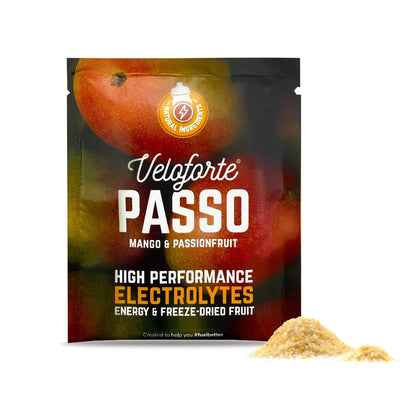
500ml Passo electrolyte drink |
55–77g |
|
2 — Solid fuel and salt |
Small handful of salted pretzels (20g plus sodium) |
500ml plain water |
55g |
|
3 — Chews and simple starches |
One small cold boiled potato with sea salt (20g) |
500ml water with electrolyte mix |
62g |
|
4 — Gel and white bread |
Slice of white bread with honey, jam, peanut butter or marmite (25g) |
500ml water, plus orange juice at the break |
47–60g |
Afternoon and evening rotation — hours 5 to 10
Hour |
On the loop |
At base camp |
Fluid |
Total carbs |
|---|---|---|---|---|
5–6 — Warm food and caffeine |
Half a cup of warm salted white rice (25g) |
500ml warm vegetable or chicken broth |
47g |
|
7–9 — Comfort food and steady energy |
Small container of mashed potato or noodles with salt (20g, low-chew) |
500ml plain water or weak hot ginger tea |
56g |
Then repeat, rotating flavours and textures, for as long as you're standing.
Hydration strategy
500–750ml every hour, in small amounts during the loop and immediately after it. Chugging a litre at base camp rarely ends well.
Electrolytes every hour. Sodium losses add up across a long day, and plain water alone won't replace them. A drink mix delivering around 1,000mg of sodium per litre gets you to 600–900mg per hour at normal fluid intakes. Factor in the salt in your food and the electrolytes already in your gels and chews.
Adjust to conditions. Hot, humid or windy days push your losses up. Drink to thirst, and expect to need more than you planned.
After: the 30 to 45 minute window
When you're finally done, recovery starts before the celebrating does.
Carbs: around 1g per kg of body weight
Protein: 20–30g, at roughly a 3:1 carb-to-protein ratio — a Nova recovery shake or chocolate milk both do the job
Fluids: replace around 1.5x the weight you lost in sweat
Electrolytes: sodium is the priority, plus potassium, magnesium and calcium
Then a proper balanced meal: carbs, protein and — now that it's safe — fibre and healthy fats
Doing your first one? Find your people
A backyard ultra is a solo effort in name only. The runners who last longest are almost always the ones who turned up with company — and who did the training miles alongside other people rather than grinding them out alone.
If you're building towards your first ultra and want that kind of support, She Strides is a good place to start.
Option A — She Strides Run Club She Strides is a women's-only run club with locations across Surrey, Hampshire and Berkshire. Every session is led by trained leaders and split into pacing groups, so it works whether you're running your first 3km or building towards your first ultra distance. You can join a run on a pay-as-you-go basis before committing to membership.
Option B — She Strides Events She Strides Events put on women's races in West Yorkshire, including their own She Strides Ultra and the Calderdale Way Ultra. Both founders are ultra runners themselves, and their events come with recces, ambassadors and a genuinely supportive field — which makes them a sound choice for a first long-distance attempt.
Find your nearest run and see what's coming up at She Strides.
We've also written a companion guide over on their site, aimed squarely at anyone tackling their very first backyard ultra.
What's the best fuel for a backyard ultra?
Carbohydrate, ahead of protein and fat. Carbs are the fuel your body can convert to energy fastest, and your glycogen stores are the tank you're managing all race. Protein and fat digest slowly and take blood flow away from working muscles, so keep them for base camp and recovery. Aim for 60–90g of carbs per hour from a mix of drinks, gels, chews, bars and simple real food.
How many calories do I need per hour, and do I really need to top up every loop?
Aim for roughly 300–400 calories per hour, and yes — every loop. It's far easier to stay topped up than to claw back a deficit at hour twelve. Split the intake: sports nutrition on the loop, real food at rest. You're burning through the loop and refuelling at base camp, so treat each hour as one complete cycle rather than trying to catch up later.
How strong should my carb drink be?
If you prefer to drink your carbs, a useful benchmark is around 60g of carbohydrate and 1,000mg of sodium per litre. That gives you a meaningful chunk of your hourly carbs and your hourly sodium in one bottle, which is one less thing to think about. Build the rest of your carb target from solid food and gels.
How much sodium do I need per hour?
Around 600–900mg per hour for most runners, which is what you'll get from 600–900ml of a drink mix delivering roughly 1,000mg of sodium per litre. Increase it in heat and humidity, or if you're a salty sweater — white marks on your kit and cap are the giveaway.
What does 60g of carbs actually look like in real food?
Handy reference points: a medium banana is around 25g. Half a jam sandwich, a mini malt loaf or three dates are each around 20g. Four ginger nut biscuits are around 25g. 150ml of orange juice is around 15g. A bagel with cream cheese is around 50g, and a thermos of pot noodle can be as much as 60g. From sports nutrition: a Veloforte energy bar is around 30g, energy chews are in the 40g range, and gels range from 22g up to 45g. Mix and match to hit your hourly target.
How do I avoid GI issues and emergency toilet stops?
Four habits do most of the work: no new foods on race day, real food you already tolerate, fibre tapering for two to three days beforehand, and little-and-often fuelling rather than large infrequent feeds. Most race-day gut trouble is a training problem — your gut needs the same rehearsal as your legs.
Do I need to carb load and taper fibre?
Both, starting three days out. Build carbs up to 8–10g per kg of body weight while cutting fibre and fat right back — white bread, bagels, white rice, white pasta and potatoes. The carbs fill your glycogen stores. Dropping fibre reduces what's left in your gut to cause trouble when you start moving.
Real food or sports nutrition — which is better?
Both, and the mix is the point. Sports nutrition is fast, concentrated, portable and predictable, which makes it ideal on the loop. Real food is bulkier and slower, but it satisfies, delivers salt and variety, and keeps you eating long after gels have lost their appeal. Salted apple juice is a perfectly good backyard ultra fuel. Practise your combination in the two weeks before the event.
What should I eat during the rest between loops?
Low fibre, low fat, and a deliberate mix of salty and sweet. Drink some of your carbs too — sugary milky tea, chocolate milk, juice and flat cola all count. As the temperature drops, switch to warm food: broth, warm rice, pot noodles. Comfort matters more than you'd think when you're deciding whether to stand up for one more lap.